


How Common Property Valuation Helps Resolve Strata Disputes
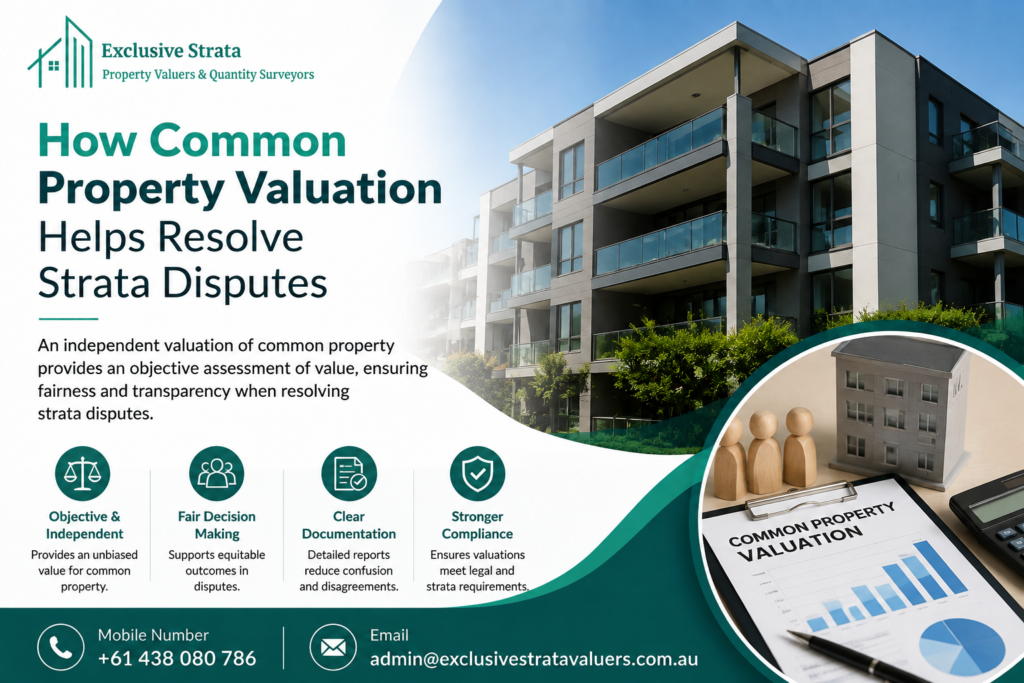
Common property sits at the heart of many strata disputes, whether the disagreement involves damage to a shared area, an owners corporation’s capital works planning, or how a shared facility should be assessed for insurance or compensation purposes. Because common property is held for the collective benefit of all lot owners rather than belonging to a single owner, disputes over its value, condition, or use can quickly become complicated. In these situations, an independent common property valuation can provide a defensible assessment that owners, insurers, mediators, or a tribunal may rely on.
This guide explains what common property valuation involves, the strata disputes it can help resolve, and why an independent assessment generally carries more weight than an informal estimate prepared by an individual owner or committee member.
SUMMARY
What This Article Covers
This guide explains what common property valuation is and how it differs from valuing an individual strata lot. It covers the disputes most commonly resolved through an independent common property assessment, including damage claims, capital works planning, insurance valuation, and unit entitlement disagreements. It also outlines what a compliant report needs to demonstrate and answers the questions owners, corporations, and strata committees ask most often about this type of valuation.
What Common Property Valuation Actually Involves
Common property valuation assesses the value of areas within a strata scheme that are owned collectively by all lot owners, such as lobbies, driveways, gardens, lifts, and shared building structures, rather than any individual apartment or lot. This is a genuinely different exercise to valuing a single strata lot, since it requires considering how the common property contributes to the overall scheme’s value and how any dispute over its condition, use, or contribution affects owners collectively rather than any one party alone.
Because common property is shared, disputes involving it often require an independent valuer to step in and provide a figure that removes personal interest from the outcome, giving the owners corporation, individual owners, or a tribunal a defensible basis for resolving the disagreement rather than continuing to argue from competing personal opinions.
This need for independence becomes especially clear in schemes where relationships between owners have already become strained, since a valuation prepared by someone with a genuine stake in the outcome is unlikely to be accepted by all parties, no matter how technically sound the underlying assessment might actually be.
Strata Disputes That Commonly Require Common Property Valuation
Several recurring situations within strata schemes bring an independent common property valuation into the picture.
Damage and Defect Claims
Where common property has been damaged, whether through a building defect, a natural event, or the actions of a specific owner or contractor, an independent valuation helps establish the genuine cost of rectification and who should ultimately bear responsibility for it.
Capital Works Fund Planning
Owners corporations need an accurate understanding of common property value and condition to plan capital works funding appropriately, and disputes sometimes arise between owners about how much should be allocated toward major repairs or replacements affecting shared areas.
Insurance Valuation of Common Property
Strata insurance valuation must account for common property alongside individual lots, and disagreements can arise where owners believe the scheme’s insured value does not properly reflect the true worth of shared facilities such as lifts, pools, or communal structures.
Unauthorised Use or Encroachment Disputes
Where an individual owner has used or altered common property without proper authorisation, an independent valuation can help quantify the impact of that use, supporting the owners corporation in resolving the matter fairly.
How an Independent Valuer Approaches Common Property Disputes
Resolving a common property dispute fairly depends on the valuer bringing genuine independence and a defensible methodology to the assessment.
Site Inspection and Condition Assessment
The valuer inspects the common property directly, documenting its current condition and any relevant damage or defects, rather than relying solely on descriptions provided by one party to the dispute.
Considering the Interests of All Owners
Because common property belongs to every owner within the scheme, a valuer preparing a report for this purpose needs to consider the interests of the ownership group as a whole, rather than favouring the position of whichever party commissioned the assessment.
What a Compliant Common Property Valuation Report Must Include
Not every assessment prepared for a strata dispute meets the standard needed to genuinely support a resolution between owners or before a tribunal.
Independence From Any Individual Owner or Committee Member
The valuer must be independent of the specific owners or committee members involved in the dispute, since a report perceived as favouring one party’s interests carries far less weight when the matter is ultimately resolved.
Clear Documentation of Methodology
A credible report explains exactly how the valuer arrived at their conclusion, referencing the specific condition, comparable schemes, or relevant strata legislation relied upon, rather than presenting a figure without supporting reasoning.
Why Independent Valuation Matters in Strata Disputes
Strata disputes involving common property can become deeply personal, particularly in smaller schemes where owners interact with one another regularly, which makes independent evidence especially valuable in reaching a fair resolution.
An independent valuation report may provide useful expert evidence during negotiations, mediation or NCAT proceedings, but it does not determine the outcome of the dispute. In NSW, mediation is compulsory for most strata disputes before an NCAT application is accepted, unless a statutory exemption applies.
When Common Property Valuation Is Needed
● When common property has been damaged and rectification costs are disputed
● When an owners’ corporation is planning capital works funding for shared areas
● When strata insurance valuation needs to account for common property accurately
● When an owner has used or altered common property without authorisation
● When a dispute over common property proceeds to mediation or tribunal
● When owners disagree about the value or condition of shared facilities
Frequently Asked Questions
Q: What is common property in a strata scheme?
A: It refers to areas owned collectively by all lot owners, such as lobbies, driveways, gardens, and shared building structures, rather than any individual apartment or lot.
Q: Why would a strata dispute need a common property valuation?
A: Disputes over damage, capital works funding, insurance value, or unauthorised use of shared areas often require an independent figure that removes personal interest from the outcome.
Q: Who commissions a common property valuation?
A: An owners’ corporation, strata committee, or a party involved in a specific dispute can commission the valuation, though the report should remain genuinely independent of any one party’s interest.
Q: Does common property valuation affect strata insurance?
A: Yes. Strata insurance valuation needs to account for common property alongside individual lots to ensure the scheme’s overall sum insured reflects genuine reconstruction requirements.
Q: Can common property valuation help resolve a tribunal dispute?
A: Yes. An independent valuation gives the NSW Civil and Administrative Tribunal or a mediator a defensible figure to work from when resolving a disputed strata matter.
Q: How does a valuer assess damage to common property?
A: The valuer inspects the affected area directly and documents its condition, providing an independent basis for establishing rectification requirements and responsibility.
Q: Does an individual owner’s unauthorised use of common property affect its value?
A: It can. An independent valuation can help quantify the impact of unauthorised use or alteration, supporting the owners’ corporation in resolving the matter fairly.
Q: Can common property valuation help with defect claims against a builder?
A: Yes. An independent assessment of common property defects can support a claim by establishing the genuine extent and impact of the issue, separate from opinions offered by any single owner.
CONCLUSION
Common property disputes within a strata scheme rarely resolve smoothly without an independent figure that all owners, or a tribunal, can genuinely trust. Whether the disagreement involves damage, capital works planning, or insurance valuation, an independent common property assessment gives everyone involved a defensible, neutral basis for reaching a fair resolution.
Engaging an experienced valuer with genuine strata expertise remains the most reliable way to resolve a common property dispute without it dragging on unnecessarily.
Need a Common Property Valuation? Contact Exclusive Strata Valuers
Exclusive Strata Valuers prepares independent common property valuations for owner corporations, strata committees, and individual owners across Sydney and NSW. Our valuers understand strata legislation and the specific dynamics of shared property disputes.
Visit exclusivestratavaluers.com.au | Sydney and NSW Wide