


How Much Does a Strata Insurance Valuation Cost in Australia?
What is the actual strata insurance valuation cost in Australia? This is one of the most practical questions a strata committee or strata manager can ask, and yet finding a straightforward answer online is surprisingly difficult. Most providers list no fees at all, which leaves owners’ corporations making decisions without the information they need. This guide sets out the typical cost of a strata insurance valuation in Australia, explains what drives the fee, and helps you understand what you should be getting for the money.
What Drives the Cost of a Strata Insurance Valuation
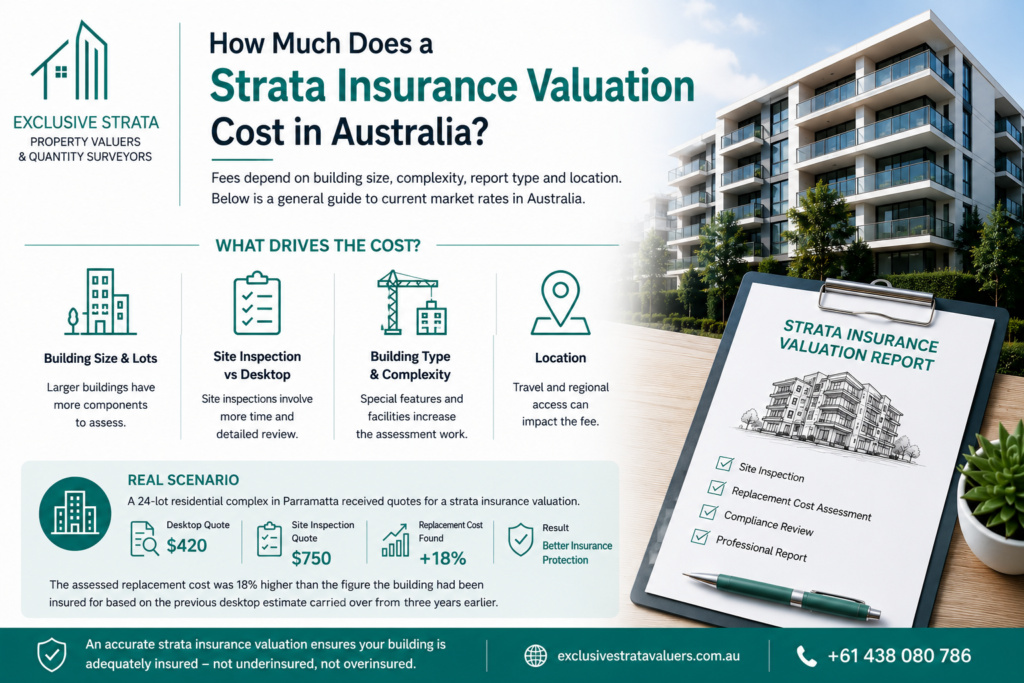
Understanding what determines the fee helps owners corporations compare quotes more accurately and identify whether a low quote reflects genuine efficiency or a reduced scope of work.
Building Size and Number of Lots
The most significant cost driver is the size of the building. A larger building has more components to assess, more common property to inspect, and a more complex set of building services. A 6-lot townhouse complex has a relatively straightforward insurance valuation. A 120-lot residential tower with basement car parking, podium landscaping, a rooftop pool, and commercial lots at ground level is substantially more work. The number of lots is a proxy for building size, but gross floor area and the range of facilities are equally important.
Site Inspection Versus Desktop Valuation
A strata insurance valuation can be prepared as a full site inspection report or as a desktop report. A full site inspection involves a qualified professional attending the building, walking through the common property, noting the construction type and specification, identifying any features that affect reinstatement cost, and inspecting accessible building services and plant rooms.
A desktop valuation is prepared without a physical inspection, relying instead on existing documentation such as strata plans, previous valuation reports, council records, and the valuer’s knowledge of similar buildings in the area. Desktop reports are generally less expensive than full site inspection reports. They are appropriate for straightforward residential buildings that have been recently valued and where the specification is well-documented. For buildings with complex facilities, unusual construction, heritage features, or where the previous valuation is significantly out of date, a site inspection is the appropriate approach.
Building Type and Complexity
Standard residential strata buildings with conventional construction, no lift, and basic common property are at the lower end of the fee range. Buildings with lifts, rooftop terraces, pools, car stackers, gymnasium facilities, or commercial components require more detailed assessment and command higher fees. Mixed use strata buildings and commercial strata properties require specialist knowledge of commercial construction rates and are priced accordingly.
Location
Fees reflect the cost of delivering the service in different markets. Capital city buildings in Sydney, Melbourne, and Brisbane generally attract fees consistent with the indicative ranges above. Regional locations may attract a travel allowance where a site inspection is required and the building is not within a reasonable distance of a major centre.
| Real Scenario |
| Real Scenario: A strata committee managing a 24-lot residential complex in Parramatta received several quotes for a strata insurance valuation. After comparing the scope of work, the committee selected the provider that included a site inspection and a comprehensive report prepared to AIQS standards. When the valuation was completed, the assessed replacement cost was 18% higher than the building’s insured value, which had been based on a desktop estimate carried forward for three years. The updated valuation gave the committee confidence that the building was now insured for a more accurate reinstatement cost, highlighting the value of choosing a thorough professional assessment rather than relying on an outdated estimate. |
What Is Included in a Proper Strata Insurance Valuation Report
When assessing quotes, it helps to know what a properly scoped strata insurance valuation should include. A report that does not cover all of the following elements may produce an inadequate replacement cost figure regardless of the fee paid.
The report should cover the full structural shell of the building including all floors, external walls, internal load-bearing walls, and roof structure. Common property finishes and fixtures, all building services including lifts, fire systems, mechanical plant, and electrical reticulation, external works including car parks, driveways, and landscaping, demolition and debris removal allowances, professional fees and statutory approval costs, and any compliance upgrade costs that would apply if the building were rebuilt today under current building regulations.
A report that lists only the gross floor area multiplied by a rate per square metre, with no identification of building-specific features, is not a comprehensive strata insurance valuation. It may produce a figure that is defensible in a general sense but will not adequately capture the true reinstatement cost of a building with premium finishes, complex facilities, or an unusual construction type.
How the Cost Compares to the Risk of Getting It Wrong
A strata insurance valuation for a mid-size residential building typically costs between $600 and $1,500. For most buildings, this represents a small fraction of one per cent of the building’s reinstatement value.
The cost of underinsurance, by contrast, can be substantial. Where a strata building is insured for less than its full replacement cost and a claim is made, the insurer may apply the co-insurance or average clause in the policy, reducing the payout proportionally. For a building with a genuine reinstatement cost of $8 million that is insured for $5 million, a claim for $400,000 worth of damage may result in a payment of only $250,000. The owners corporation must fund the shortfall through a special levy on lot owners.
The fee for an independent strata insurance valuation is a legitimate expense of the owners corporation and is funded from the administrative fund. It is one of the more cost-effective risk management measures an executive committee can take on behalf of lot owners.
| Key Point |
| The Australian Institute of Quantity Surveyors recommends that strata buildings obtain an independent insurance valuation every three years and a desktop review in intervening years. The cost of this cycle, spread across all lot owners in the building, is typically less than $10 per lot per year in a medium-size residential scheme. |
Questions to Ask When Comparing Quotes
Not all strata insurance valuation reports are equivalent, and the lowest fee does not always represent the best value. When comparing quotes, the following questions help identify whether the scope of work is appropriate for the building.
Ask whether the report includes a site inspection or is prepared as a desktop assessment. Ask whether the professional holds membership of the Australian Institute of Quantity Surveyors or holds a Certified Practising Valuer designation. Ask whether the report will include demolition costs, professional fees, and compliance upgrade allowances as separate line items. Ask whether the report will be signed by the preparing professional and clearly state the effective date of the valuation. And ask whether the provider is willing to explain the methodology if the sum insured figure is queried by the insurer or the owners corporation.
A provider who answers these questions clearly and confidently is producing a report that will stand up to scrutiny. One who cannot or will not explain their methodology is unlikely to be producing a report of the standard required.
Conclusion
A strata insurance valuation provides owners corporations with an accurate assessment of a building’s replacement cost, helping ensure the sum insured reflects current construction and rebuilding conditions. Commissioning an independent valuation from a qualified professional helps protect every lot owner from the risks of underinsurance and provides a well-supported basis for determining the appropriate level of insurance cover. Regular updates also help ensure the valuation remains aligned with changes in construction costs and building conditions over time.
| Want to know exactly what a strata insurance valuation will cost for your building? Exclusive Strata Valuers provides fixed fee quotes with no obligation. Contact us at exclusivestratavaluers.com.au |
Frequently Asked Questions
Is a strata insurance valuation a one-off cost or does it need to be paid regularly?
A strata insurance valuation should be completed every three years as a full independent report, with a desktop review in the intervening years. It is a recurring cost of the owners corporation, funded from the administrative fund. Treating it as a one-off expense and then carrying the same figure forward indefinitely is one of the most common causes of underinsurance in strata buildings.
Can the owners corporation negotiate the fee with the valuer?
Yes. Fees are not regulated and providers will negotiate, particularly for long-term relationships or where the owners corporation manages multiple buildings. Strata managers who place multiple valuations with a provider regularly may receive preferential rates. However, negotiating on fee alone without regard to the scope of the report may result in a desktop assessment being substituted for a site inspection report, which is not always appropriate.
Is the cost of a strata insurance valuation tax deductible?
The cost is a legitimate expense of the owners corporation and is funded from the owners corporation’s administrative fund, to which all lot owners contribute through their levies. For investment property owners, the levy contribution is generally deductible as a cost of managing the investment property. Individual lot owners should seek advice from their accountant regarding the deductibility of levy contributions that include the valuation cost.
What is a desktop strata insurance valuation and when is it appropriate?
A desktop valuation is prepared without a physical inspection of the building. It relies on existing documentation, comparable building data, and the valuer’s knowledge of the area and building type. It is appropriate for straightforward residential buildings with standard construction that have been recently valued and where no significant changes have occurred. It is not appropriate for complex buildings, buildings with premium or unusual finishes, or buildings where the previous valuation is significantly out of date.
Why do some quotes for a strata insurance valuation cost seem very low?
Very low quotes typically reflect a reduced scope of work, usually a desktop assessment based on floor area and a generic rate rather than a building-specific analysis. These reports may be adequate for simple buildings but will not capture the true reinstatement cost of a building with complex facilities, premium finishes, or unusual construction. When comparing quotes, ask specifically what the report includes and whether a site inspection is part of the scope.